Looking Beyond the Price Tag: Why Long-term Value Matters in Cast Stone Specification
13 Aug 2026
As regulatory requirements evolve, aluminium system manufacturers are increasingly focused on developing products that help architects and contractors meet performance, compliance and design objectives.
With changes such as the Building Safety Act and the introduction of the Future Homes Standard, specification decisions require greater consideration and supporting evidence. Here, Chris Newman, Product Development and Engineering Manager at Reynaers Aluminium UK, explains how Reynaers’ approach to product development, testing and collaboration helps support informed specification choices.
Product development is typically driven by two factors: a shift in market demand and the need for adaptation of systems to meet updated regulations, building practices and design expectations. At Reynaers we take a holistic approach to bringing new products to market, asking ourselves what problem does the product solve, why this product or update is needed at this time, and what do architects and end clients require from Reynaers’ products. Taking this feedback into account allows us to offer practical solutions that benefit the industry and help to tackle defined challenges.
It takes a vast amount of time and investment in both research and development, but also in testing, to bring a new product to market, and with this in mind it is prudent to revisit, and enhance existing, proven and popular products whilst also looking at bringing new innovations to market.
Established systems have been proven, which is attractive to installers and fabricators who play a key role in the route to market – while familiarity with the system supports speed of installation and fabrication. Where a product can be updated to meet market demand this makes sense from an installer and fabricator perspective as they already work with the product and have a good understanding of it.
With this in mind, Reynaers focuses on the continuous evolution of its entire product portfolio, carefully balancing innovation with the ongoing development of existing systems. This approach ensures that both our customers and our internal teams are part of the journey as our solutions evolve.
Reynaers is widely recognised for its strong commitment to product development and rigorous testing. Even after a product has been successfully launched, we continue to review, refine and enhance it to ensure we deliver the best possible range of solutions to our customers.
Where new regulatory requirements must be met and existing systems cannot be adapted, we develop new solutions designed to achieve the required standards. The increasing demand for more thermally efficient glazing systems, driven by the push towards net zero, is a clear example of this.
While we were able to upgrade existing systems, there was also a clear need to develop forward-looking, sustainable solutions that combine low U-values with reduced embodied carbon and support circular design principles.
As a result, while MasterPatio remains a flagship sustainability product for Reynaers, we have expanded our range of thermally efficient systems with the introduction of MasterLine 8 and MasterLine 10. These systems are designed to deliver exceptional performance, achieving thermal efficiencies that can meet Passive House standards.
The need for improved thermal efficiency has also driven product development for the renovation market. Renovation offers a more sustainable route to meeting construction targets, with lower U-values in curtain walling and windows systems helping projects achieve BREEAM status. This must also be balanced with aesthetic design that complements heritage properties.
As a European company, Reynaers is experienced in developing products for different markets, taking into account regional standards, regulations and expectations. For architects and contractors, specifying a well-established product with proven performance data and tested details helps reduce risk and provides confidence throughout the design and delivery process.
As performance requirements become increasingly complex, specifiers need access to reliable information, tested solutions and products that can demonstrate compliance. Systems houses therefore have a responsibility to continually develop their offer, supporting informed decisions across the supply chain.
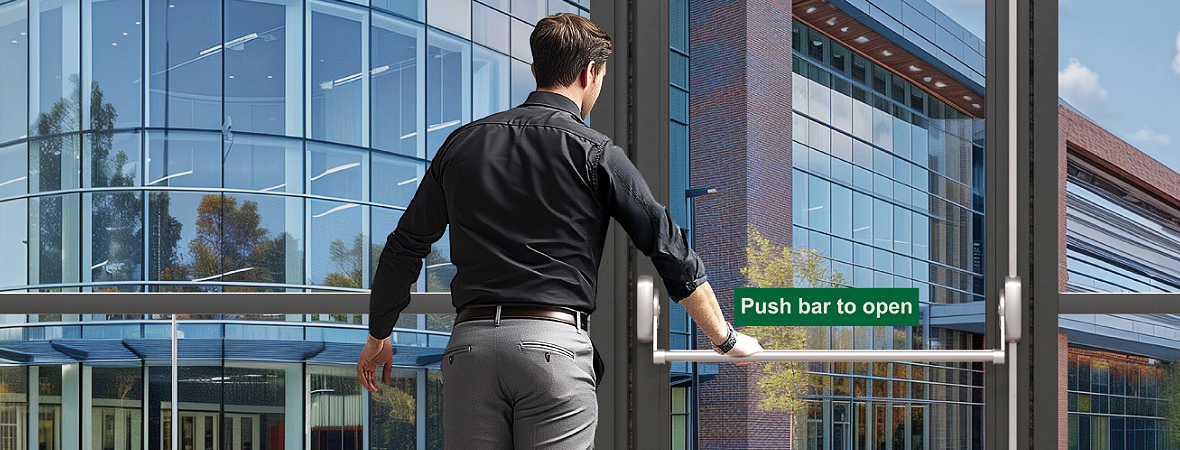
The approach is reflected in Vision 7, Reynaers’ latest commercial entrance door system. Certified to STS202 BR1 and BR2, PAS 24 and EN 12400 Class 8 for mechanical durability, it is well suited to education and healthcare projects where specification must demonstrate compliance with security requirements and meet the increasing scrutiny applied to publicly funded schemes. Critically, it has also been designed to simplify fabrication, helping ensure the specified product is built and installed as intended, reducing the risk of programme delays or quality issues.
Product innovation is therefore not only about responding to current requirements but anticipating future needs and ensuring systems continue to align with changing industry expectations.
The foundation of bringing any new system, product or update to market is testing, which must be considered from the earliest stages of development. Commitment to the highest standards of testing to demonstrate performance is a key part of Reynaers’ ethos. Testing not only serves to demonstrate compliance, but it should guide design decisions, especially as the specification model shifts following the introduction of the Building Safety Act (BSA).
Rigorous testing for quality, security and performance underpins every Reynaers product. This includes assessments for air and water tightness, wind resistance and durability. All systems are comprehensively tested at the Reynaers Technology Centre in Duffel, one of the largest third-party accredited façade testing facilities in Europe.
All testing should be independently verified and the data from that made accessible to provide assurance to all stakeholders throughout the entire project, with traceability and transparency key to achieving best practice in line with the BSA.
Successful product development, system launches and updates are never achieved in isolation. Reynaers’ philosophy is built on innovation through collaboration, bringing together fabricators, installers, architects and developers throughout the process.
This collaboration does not end when a new product is introduced to the market. Ongoing support—from design through to installation—is essential to ensuring the success and longevity of projects. It also plays an important role in addressing wider industry challenges that affect all stakeholders, such as regulatory change.
By working closely with Architects and specifiers, Reynaers can prioritise efficiency while gaining a deeper understanding of their practical requirements. Progress depends on continuous evolution, and stakeholder feedback is central to how Reynaers’ systems are developed to perform effectively in real-world applications. Looking ahead to anticipate construction trends and regulatory developments is essential in helping ensure that the right products and system updates are delivered at the right time.