AES Delivers Whole-house Retrofit for Cambridge Housing Society
11 Aug 2026

For architects and the wider housebuilding community, the Future Homes Standard is a major milestone for residential development in the UK. New homes will be expected to deliver 75-80% lower carbon emissions compared with homes built under 2013 regulations, fundamentally changing how developments are designed, serviced and delivered.

The challenge for the sector is no longer whether low-carbon development is coming, it is how quickly the industry can adapt its design, infrastructure and delivery models to meet it.
For architectural technologists and housebuilders alike, this transition extends far beyond replacing gas boilers with heat pumps. It demands a complete rethink of how utility infrastructure is planned at the earliest stages of development, how communities are connected to energy systems, and how future resilience is embedded into residential placemaking.
At the heart of this shift lies one critical question: can the traditional approach to utilities still support the homes of the future?
Historically, utilities have often been treated in siloes within development programmes. Electricity, gas, water, fibre and heating infrastructure were typically designed independently, procured separately and delivered sequentially. That model is becoming incompatible with the Future Homes Standard.
The removal of fossil-fuel heating from new homes means electricity demand across developments will rise significantly as heating, hot water, electric vehicle charging and smart technologies become electrified. At the same time, planning policy and consumer expectations are driving higher standards of energy efficiency, renewable integration and digital connectivity, creating a new level of complexity for development teams.
Architectural technologists should now start to coordinate building fabric performance, ventilation systems, thermal modelling and low-carbon heating strategies in parallel with utility infrastructure design. Housebuilders, meanwhile, face growing pressure to deliver compliant homes while protecting programme certainty, controlling costs and maintaining viability.
What’s becoming clear is utilities can no longer be considered as late-stage technical requirements – they must become a core part of strategic master planning from day one.
While individual air source heat pumps will play an important role in the transition to low-carbon housing, they are unlikely to be the optimal solution for every development type.
Residential schemes, mixed-use communities and large-scale strategic developments require more scalable and efficient solutions, and this is where low-carbon heat networks are becoming increasingly important.
The Future Homes Standard explicitly identifies heat networks as one of the principal technologies capable of delivering compliant low-carbon heating for new homes.
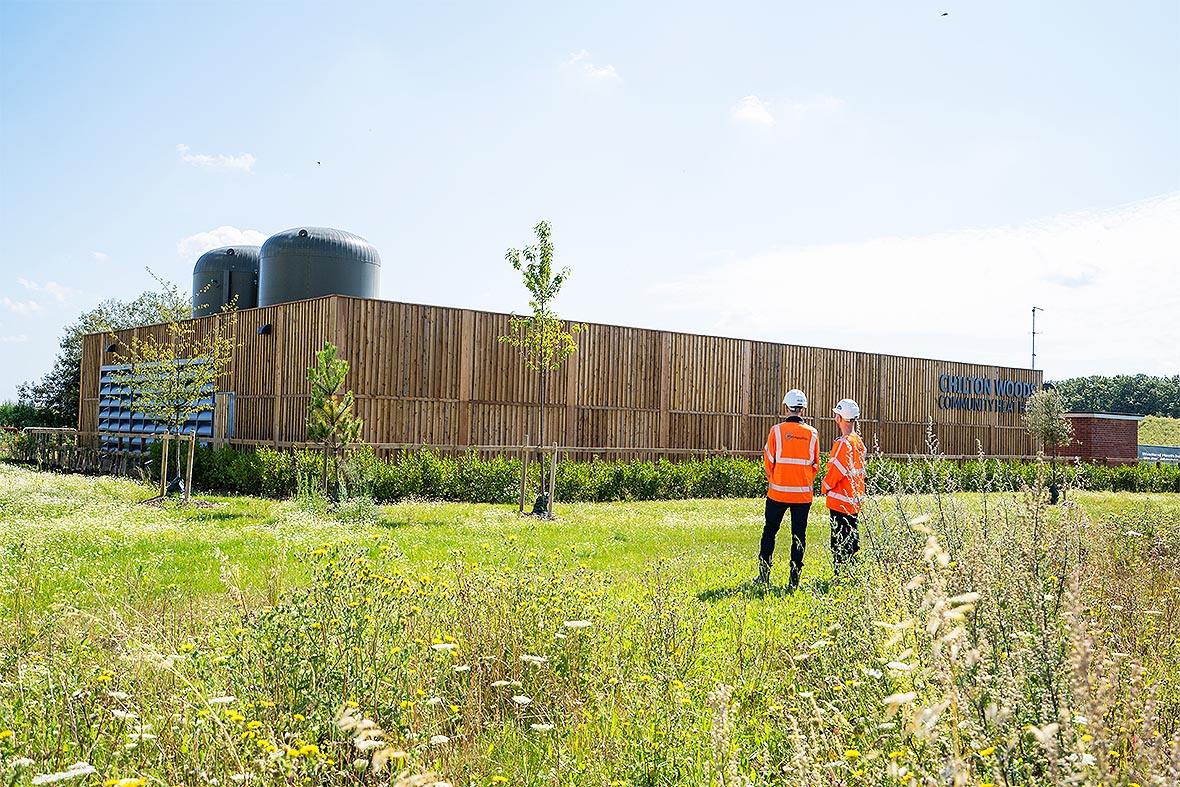
Modern heat networks differ significantly from legacy district heating systems of the past. New-generation networks can integrate ambient loops, networked ground source heat pumps, and renewable energy sources to create highly efficient, flexible energy systems across entire communities. What’s more, they are being rolled out on low- and high-density schemes.
For developers, the benefits are substantial.
A well-designed low-carbon heat network can:
Importantly, heat networks also support a more holistic placemaking approach.
Rather than treating each dwelling as an isolated energy asset, networked systems enable developments to operate as connected communities with shared infrastructure capable of evolving over time.
For architectural technologists, this opens new opportunities to integrate energy strategy directly into the design narrative of developments, influencing everything from building orientation and massing to utility corridors and public realm planning.
One of the biggest risks facing the sector is underestimating the scale of infrastructure transformation required to support electrified housing.
As the industry moves away from gas, electricity networks will experience unprecedented pressure. Developments designed around individual heating systems alone may encounter challenges relating to grid capacity, reinforcement costs and connection delays. This is already emerging as a major concern across the housebuilding sector.
Future-proofed developments will therefore require smarter approaches to infrastructure integration, as opposed to simply more infrastructure. This is where the multi-utility model becomes increasingly valuable.
By coordinating electricity, water, fibre and low-carbon heat infrastructure through a single integrated delivery model, developers can unlock significant efficiencies in both design and construction.
Instead of multiple contractors excavating the same roads and footpaths at different stages, integrated utility delivery enables infrastructure to be planned, installed and managed cohesively.
The result is reduced disruption, improved programme certainty and better long-term asset performance. More importantly, integrated multi-utility infrastructure creates the foundation for genuinely smart communities.
As homes become increasingly connected and data-driven, utility systems will need to interact seamlessly. Energy management, heating optimisation, EV charging and digital monitoring will all rely on coordinated infrastructure ecosystems rather than standalone networks.
The Future Homes Standard is therefore accelerating a much broader evolution in residential development, from disconnected housing sites to integrated low-carbon communities.
While much of the conversation around the Future Homes Standard focuses on regulation, the real opportunity is much larger.
The UK is entering a new era of residential development where energy resilience, digital connectivity and low-carbon infrastructure will become defining characteristics of successful communities.
Consumers are becoming more aware of operational energy costs, sustainability performance and long-term home resilience. Investors and local authorities are placing greater emphasis on ESG outcomes and future-ready infrastructure. At the same time, national net zero targets continue to reshape planning and development policy.
In this environment, low-carbon heat networks and integrated multi-utility infrastructure are not simply compliance mechanisms, they are strategic assets. They enable developers to differentiate schemes, improve long-term value creation and build communities capable of adapting to future technological and environmental change.
For architectural technologists, this represents an opportunity to play a far more influential role in shaping how future communities function, perform and evolve.
And for housebuilders, it reinforces an increasingly important reality: the homes of the future will only be as resilient as the infrastructure that supports them.
The Future Homes Standard may have accelerated the timeline for change, but it has also created an opportunity for the industry to rethink residential development; moving beyond isolated buildings towards integrated, low-carbon communities designed for the next generation.